Table of Contents
If the NDA written exam is a test of your knowledge, the Services Selection Board (SSB) Interview is a test of your soul. It is widely regarded as one of the most scientific and toughest selection processes in the world. Why? Because the military isn’t looking for the smartest person in the room—they are looking for the “right” person.
The SSB is a five-day psychological journey designed to peel back your layers and see if you possess the 15 Officer Like Qualities (OLQs). It is a transition from being a candidate to being a potential leader of men and women.
SSB: The Selection Excellence Program
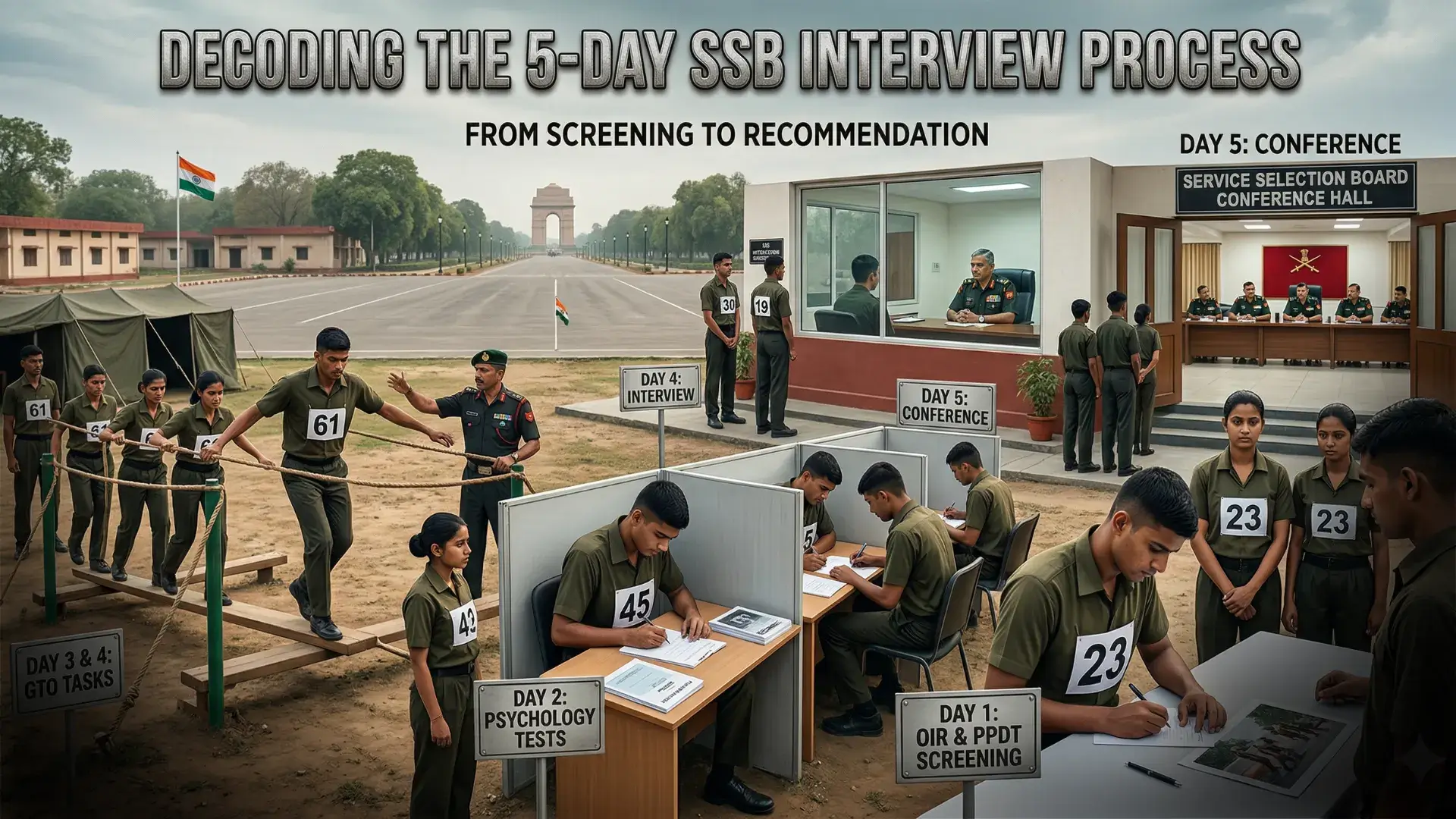
Day 1: The Filter (Screening)
The first day is often the most nerve-wracking because it’s an elimination round. Nearly 60–70% of candidates are sent home by lunchtime.
- OIR (Officer Intelligence Rating): You’ll face two booklets of verbal and non-verbal reasoning. It’s a race against time.
- PPDT (Picture Perception & Discussion Test): You are shown a blurry picture for 30 seconds. You must write a story, narrate it, and then discuss it with your group to reach a consensus.
- The Goal: The assessors are looking for clarity of thought, a positive mindset, and the ability to influence a group without being a bully.
Day 2: The Deep Dive (Psychology Tests)
Once you are “Screened-In,” the real work begins. Day 2 belongs to the Psychologist, who wants to see your subconscious mind.
- TAT (Thematic Apperception Test): 11 pictures + 1 blank slide. You write stories for each. It’s not a creative writing contest; it’s a projection of your personality.
- WAT (Word Association Test): 60 words appear for 15 seconds each. You write the first sentence that comes to mind.
- SRT (Situation Reaction Test): 60 real-life “what would you do?” scenarios.
- SD (Self-Description): You write what your parents, teachers, and friends think of you. Honesty is the only policy here; faking it is the fastest way to get rejected.
The 120-Hour Transformation: Inside the SSB
If the NDA written exam is a test of your knowledge, the Services Selection Board (SSB) Interview is a test of your soul. It is widely regarded as one of the most scientific and toughest selection processes in the world. Why? Because the military isn’t looking for the smartest person in the room—they are looking for the “right” person.
The SSB is a five-day psychological journey designed to peel back your layers and see if you possess the 15 Officer Like Qualities (OLQs). It is a transition from being a candidate to being a potential leader of men and women.+1
Day 1: The Filter (Screening)
The first day is often the most nerve-wracking because it’s an elimination round. Nearly 60–70% of candidates are sent home by lunchtime.+1
- OIR (Officer Intelligence Rating): You’ll face two booklets of verbal and non-verbal reasoning. It’s a race against time.
- PPDT (Picture Perception & Discussion Test): You are shown a blurry picture for 30 seconds. You must write a story, narrate it, and then discuss it with your group to reach a consensus.
- The Goal: The assessors are looking for clarity of thought, a positive mindset, and the ability to influence a group without being a bully.
Day 2: The Deep Dive (Psychology Tests)
Once you are “Screened-In,” the real work begins. Day 2 belongs to the Psychologist, who wants to see your subconscious mind.
- TAT (Thematic Apperception Test): 11 pictures + 1 blank slide. You write stories for each. It’s not a creative writing contest; it’s a projection of your personality.
- WAT (Word Association Test): 60 words appear for 15 seconds each. You write the first sentence that comes to mind.
- SRT (Situation Reaction Test): 60 real-life “what would you do?” scenarios.
- SD (Self-Description): You write what your parents, teachers, and friends think of you. Honesty is the only policy here; faking it is the fastest way to get rejected.
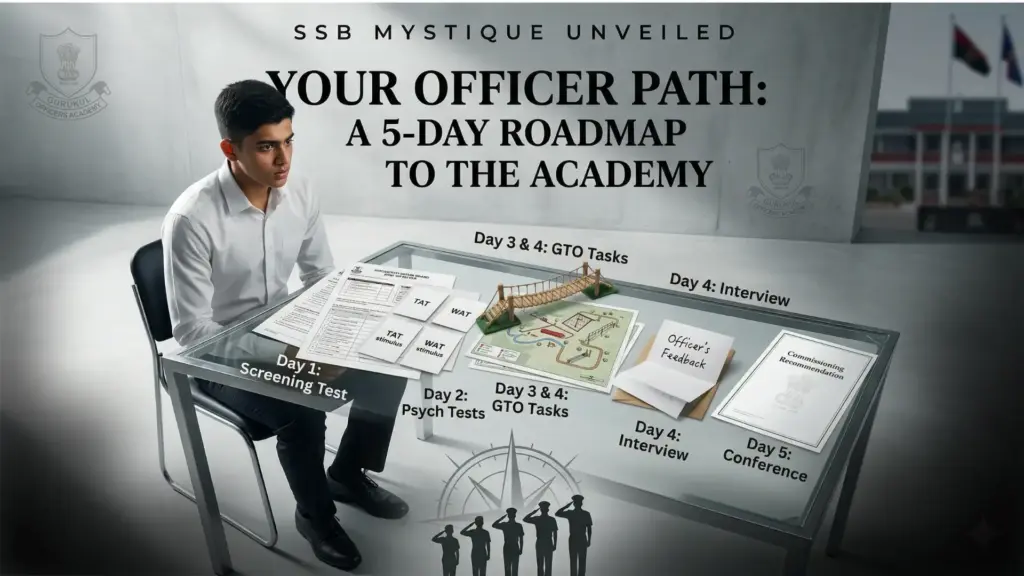
Day 3 & 4: The Ground Reality (GTO Tasks)
The Group Testing Officer (GTO) takes you outdoors. This is where your teamwork and physical grit come into play.
- Group Tasks (PGT/HGT): You’ll use planks, ropes, and wooden logs to cross obstacles with your team.
- Command Task: You are made the “Commander” and given a task. You choose two subordinates to help you. This tests your ability to lead, delegate, and solve problems under pressure.
- Individual Obstacles: 10 physical obstacles (like the Tarzan Swing or Burma Bridge) to test your guts and stamina.
- Lecturette: You speak for 3 minutes on a random topic. It’s about your confidence and “Power of Expression.”
The Personal Interview (Day 2 to 4)
At some point during these days, you’ll be called for a one-on-one with the Interviewing Officer (IO). This can last from 30 minutes to over an hour. It’s a deep conversation about your life, family, hobbies, and current affairs. The IO is looking for transparency and consistency. If your TAT stories say you are brave, but your interview shows you avoid responsibility, the contradiction will be caught.
Day 5: The Judgment (Conference Day)
On the final day, all the assessors—the Psychologist, the GTO, and the IO—sit together in full uniform. This is the Conference.
You are called into a room for about 30 seconds to 2 minutes. They might ask a simple question like, “How was your stay?” or a “situation” if you are a borderline case. After everyone has been called, the results are announced.
Also Read : The People’s Academy: Empowering Dreams at India’s Sainik Schools
Final Words: It’s About Who You Are
The most important thing to remember about the SSB is that you cannot “prepare” for it like a history exam. You have to evolve into it. The military doesn’t want “rehearsed” answers; they want a human being who is reliable, resilient, and ready to put the team before themselves.
If you are recommended, you head to the Medical Board. If not, you take the experience, learn from it, and come back stronger. As they say in the forces, “SSB is not a test of your past, but a promise of your future.”
FAQ’s
1. What is the most common reason for being “Screened Out” on Day 1?
Poor narration and lack of contribution in the PPDT discussion. Even if your story is great, if you can’t speak clearly or if you remain silent during the group discussion, the assessors won’t have enough data to “screen you in.”
2. Do I need to speak fluent English to get recommended?
While the medium of instruction is English, you don’t need a “posh” accent. As long as you can communicate your thoughts clearly and understand others, you are fine. If you get stuck, you can speak in Hindi briefly, but switch back to English as soon as possible.
3. Can a “Repeater” ever get selected, or is the first attempt the only chance?
Absolutely. In fact, many high-ranking officers today were “Repeaters.” The SSB values someone who learns from their past failures, works on their weaknesses, and comes back with more maturity.
4. What should I do if I don’t know the answer to a GK question?
Never bluff. Simply say, “I am sorry, Sir, I don’t know the answer right now, but I will find out.” The Interviewing Officer (IO) is testing your honesty and composure, not just your memory.
5. Is it okay to have a girlfriend or boyfriend?
Yes. The IO often asks this to check your emotional maturity and social adjustment. Be honest. If you have one, say so; if not, say you are focusing on your goals. They are looking for a normal, balanced human being, not a monk.
6. How many “Individual Obstacles” must I complete to pass?
There is no fixed number, but aim for at least 8 to 10. If you finish all 10 and still have time, you can repeat them for extra marks. It’s about your physical stamina and “Guts” to take on the harder ones first.
7. What if my group is “Fish Market” (everyone shouting) during GD?
Do not join the shouting match. Wait for a split-second pause, give a logical point, and try to bring the group back to the topic. Assessors notice who is trying to be a “leader” versus who is just a “shouter.”
8. Can I get rejected for being too short or wearing glasses?
Medical standards are separate from the 5-day interview. You can be “Recommended” by the board even with glasses, but you might be “Medically Unfit” later if your eyesight exceeds the limit for your specific wing (Pilot, Navy, etc.).
9. Why does the IO ask about my “Pocket Money” or “Salary”?
To check your Sense of Responsibility. They want to see if you are thrifty, how you help your family, and if you plan your finances. It shows whether you are a mature adult or still dependent on others for basic logic.
10. Does a “Conference Out” candidate have a lower chance next time?
No. Every SSB attempt is a fresh start. The new board of assessors does not see your previous marks. They only see you as you are today. Use the previous experience to stay calm and perform better.