Table of Contents
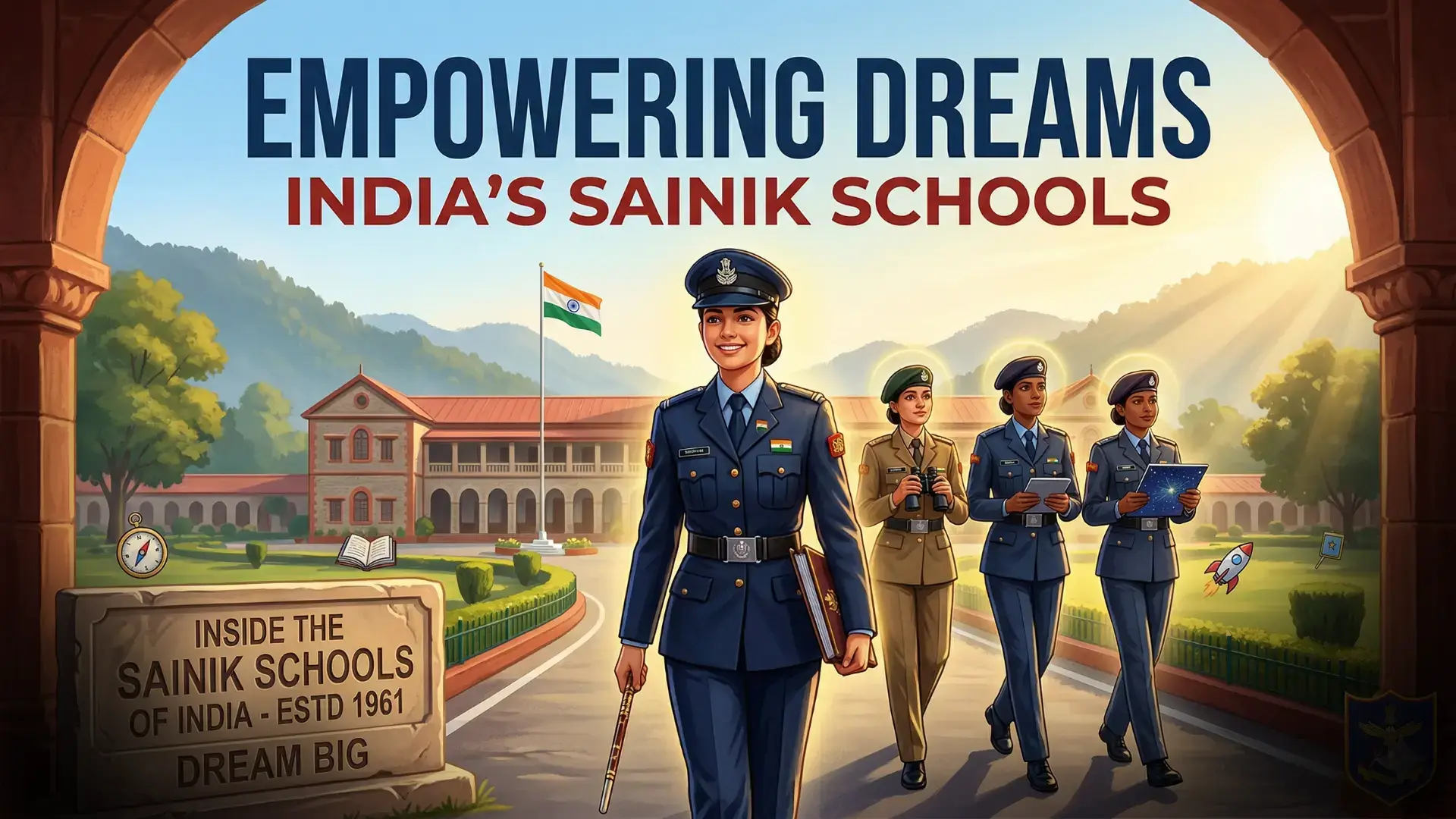
If the RIMC is a specialized elite boutique and the RMS is a legacy military stronghold, then the Sainik Schools are the grand, sweeping corridors of opportunity for the common Indian citizen. Established in the early 1960s by the visionary then-Defence Minister, V.K. Krishna Menon, these schools were created with a radical goal: to democratize the officer cadre of the Indian Armed Forces. The idea was simple but powerful—remove the regional and social imbalances in the military by picking up bright, gritty children from every corner of India and polishing them into leaders.
Today, with over 33 established schools and a growing network of new “Partnership Mode” schools, the Sainik School Society has become the single largest contributor of cadets to the National Defence Academy (NDA).
A Pan-India Legacy of Excellence
From Sainik School Rewa in the heart of India to Sainik School Kazhakootam in the far south, each campus is a mini-India. These schools aren’t just for the children of soldiers; they are open to every Indian citizen. This “open-door” policy has created a unique culture where the son of a farmer sits in the same classroom as the daughter of a high-ranking bureaucrat, both wearing the same khaki uniform and chasing the same dream of wearing the stars.
The schools are managed by the Sainik Schools Society under the Ministry of Defence, with the Chief Ministers or Education Ministers of the respective states often taking a personal interest in their development.
Sainik School Entrance: The Elite Preparation Batch
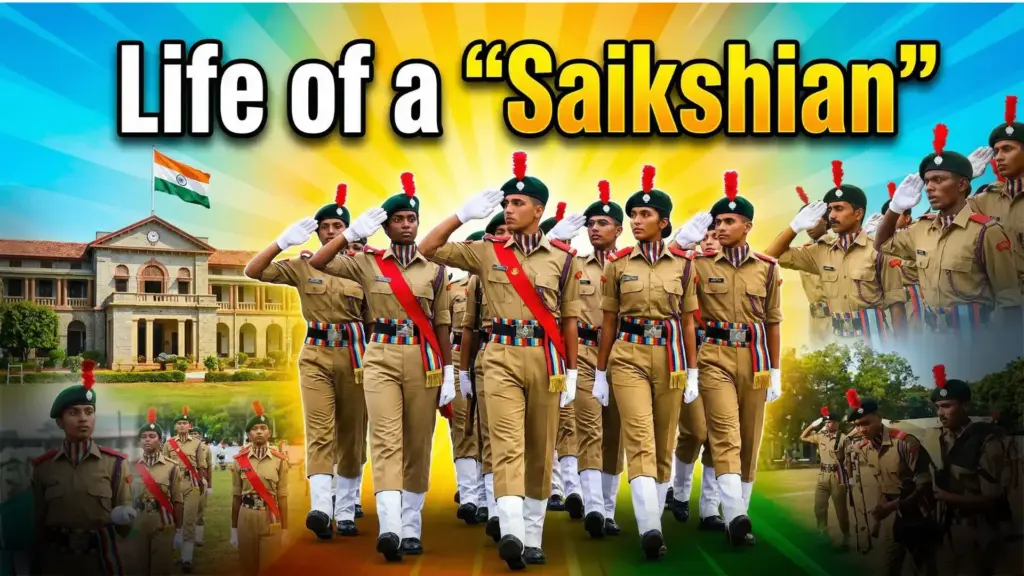
The Transformation: Life of a “Saikshian”
The students of these schools are proudly called “Saikshians.” Their life is a masterclass in self-reliance. While elite boarding schools might pamper their students, a Sainik School builds character through “constructive hardship.”
The Morning “Fall-In”
Life starts at 05:30 AM with the whistle of the physical training instructor. Whether it’s the biting cold of Sainik School Ghorakhal or the humid mornings of Sainik School Korukonda, the cadets are out on the field for PT or cross-country runs. This daily ritual isn’t just about fitness; it’s about conquering the urge to stay in bed—a cadet’s first victory of the day.
Academics and the “UPSC Mindset”
Sainik Schools follow the CBSE curriculum, but with a sharp focus on the All India Sainik Schools Entrance Examination (AISSEE) standards. From Class 6 onwards, the logic, math, and English skills of the students are sharpened with one goal in mind: the UPSC NDA entrance exam in Class 12. The teachers aren’t just educators; they are mentors who understand the psychological profile required for a future military leader.
The “House” Spirit
Every cadet belongs to a “House” named after Indian heroes or historical figures. The House is where they learn the most important military lesson: Loyalty. Whether it’s an inter-house debate, a football match, or a drill competition, the “Saikshian” learns to put the honor of the House above their personal glory.
A Historic Shift: The Entry of Girls
For decades, Sainik Schools were an all-male bastion. However, following a successful pilot project in Mizoram, the doors were flung open for girl cadets nationwide in 2021. This move has been transformative. Today, young girls are not just joining; they are topping the entrance exams and proving that “Officer Like Qualities” (OLQs) have no gender. They train on the same obstacle courses and study the same tactical maps, preparing for a future where they will lead troops on the front lines.
Also Read : The West Point of India: Inside the Hallowed Portals of RIMC Dehradun
The “New” Sainik School Model
In 2024-25, the government introduced a major expansion: 100 New Sainik Schools in partnership with NGOs, private schools, and state governments. While the core 33 schools remain the traditional pillars, this expansion is bringing the “Sainik School Culture”—discipline, patriotism, and physical rigour—to thousands of more students across the country.
Conclusion: The Gateway to a Life of Honor
Choosing a Sainik School is a commitment to a life of service. It’s for the parent who wants their child to be disciplined, physically invincible, and deeply patriotic. The motto, “Gyan, Vigyan, Chaitanya” (Knowledge, Science, Spirit), reflects the school’s mission to produce citizens who are intellectually bright and spiritually strong.
When a 10-year-old enters the gates of a Sainik School, they carry a school bag. When they leave seven years later, they carry the “Josh” and the character to lead the nation.
FAQ’s
1. Can girls apply for Class 9?
Yes. While girls initially only entered Class 6, they are now eligible for Class 9 as well, provided the specific Sainik School has vacancies for them. Always check the school-specific seat matrix before applying.
2. What is the “New Sainik School” (NSS) model?
These are private or NGO-run schools that have partnered with the government to follow the Sainik School curriculum. You can apply for both Traditional and New schools in the same AISSEE form.
3. My child is in Class 6 already; can he apply for Class 6 again?
No. To join Class 6, the child must be currently in Class 5 (or passed it). Repeating a grade just to get into Sainik School is generally not allowed and can lead to disqualification during document verification.
4. Is there a “Home State” advantage?
Huge. 67% of seats in any Sainik School are reserved for candidates from that specific state. The remaining 33% are open to candidates from other states. This makes getting into your home-state school much easier.
5. Can I change my school choice during e-counseling?
Yes. After the written result (AISSEE), you participate in e-counseling. You can choose multiple schools (including New Sainik Schools) in your order of preference, even if you didn’t list them all in the initial form.
6. Are Sainik Schools completely free?
No. While they are government-aided and much cheaper than private boarding schools, there is an annual fee (approx. ₹1.4 Lakhs to ₹1.8 Lakhs). However, many students get State or Ministry of Defence scholarships based on merit and income.
7. What if my child is slightly overweight?
Unlike the NDA, Sainik Schools are a bit more lenient on height and weight for 10-year-olds since they are in a growing stage. However, extreme obesity or a weak constitution can lead to rejection during the medical round.
8. Do cadets get to come home for festivals?
Generally, no. Cadets only get to go home during the Summer and Winter breaks (approx. 70 days a year). For short festivals, the school celebrates on campus to maintain discipline and routine.
9. Is coaching mandatory to clear the AISSEE?
Not mandatory, but competitive. The exam isn’t just about school books; it includes Intelligence (OIR) and high-speed Mathematics. Many students use coaching to get used to the OMR-sheet format and time management.
10. Can a Sainik School student become a Doctor or Engineer?
Yes. While the primary goal is the NDA, the CBSE curriculum and discipline prepare them for any field. Many “Saikshians” successfully join IITs, AIIMS, or clear the UPSC Civil Services (IAS/IPS).