Table of Contents
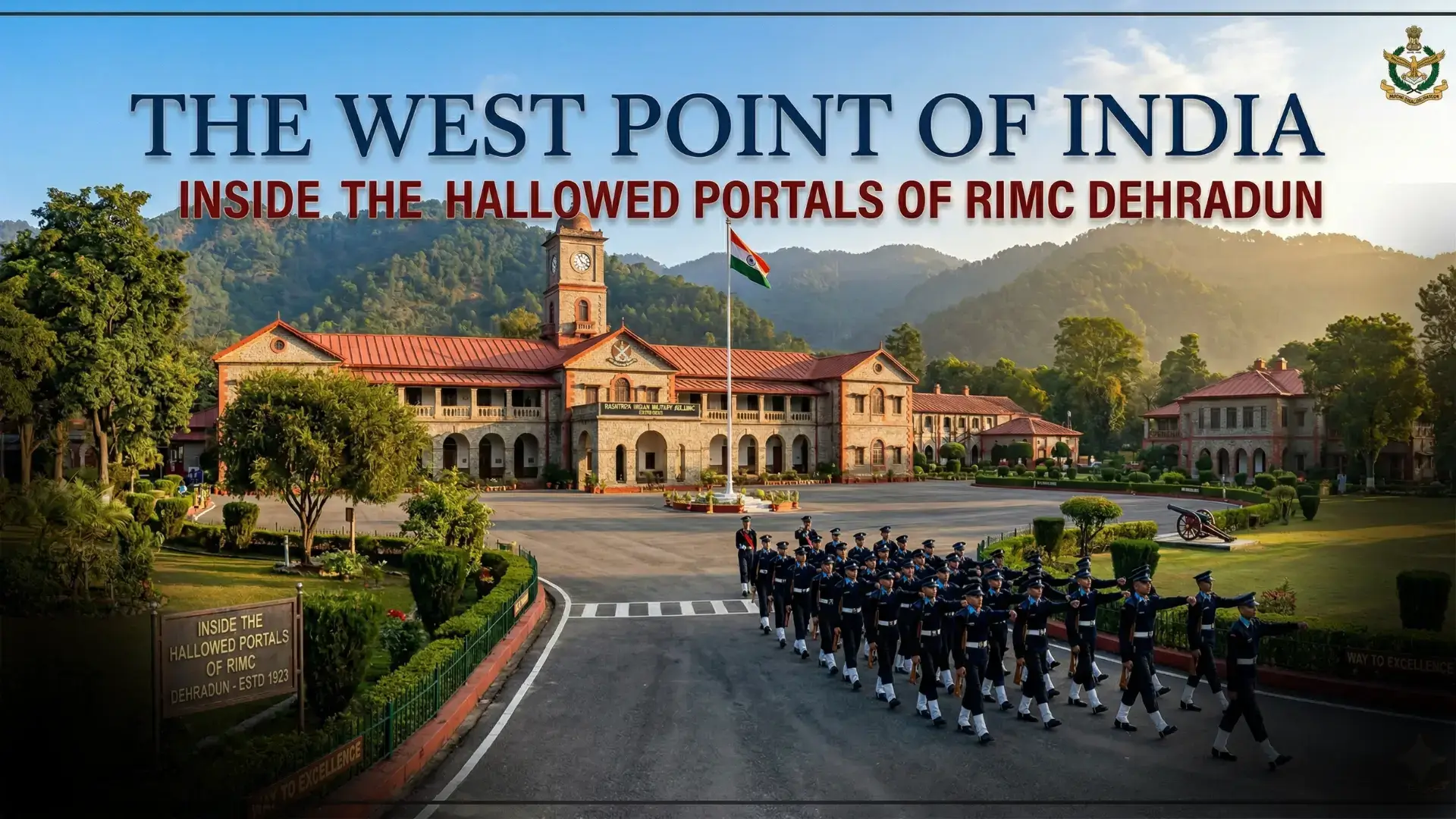
If the National Defence Academy is the final gateway to becoming an officer, then the Rashtriya Indian Military College (RIMC) is the sacred soil where the seed is first planted. Located in the serene Doon Valley, RIMC isn’t just a school; it’s a century-old institution that has produced the highest number of Service Chiefs in the Indian Armed Forces. Established in 1922, it holds a unique status as a “Category A” establishment under the Ministry of Defence, designed with one singular vision: to be the premier feeder for the NDA.
To a student, being a “Rimcollian” is a badge of honor that carries the weight of history and the promise of a future dedicated to the nation.
A Century of Valour and Vision
RIMC was inaugurated on March 13, 1922, by the Prince of Wales, who famously remarked, “It is the first few blows on the anvil of life that give the human weapon the set and temper that carry him through life’s battles.” This philosophy remains the heartbeat of the campus. Unlike other military schools that admit hundreds, RIMC is a boutique institution, admitting only about 25 cadets every six months.
This scarcity makes it one of the most exclusive and difficult schools to enter in Asia. The campus, spread across 138 acres of lush greenery in Dehradun, feels more like a heritage military cantonment than a school, with Tudor-style architecture and walls adorned with the portraits of Param Vir Chakra winners and former Army Chiefs.
From Classroom to Campus: Your Journey to Rashtriya Military School
The “Guru-Shishya” Ethos: Life in the Doon Valley
Life at RIMC is governed by the traditional Indian value of mutual respect between the teacher and the taught. However, that “respect” is wrapped in a schedule that would break the average teenager.
Precision in Routine
The day begins at 05:30 AM with the crisp morning air of Dehradun. Cadets engage in PT (Physical Training) or Drill, where the sound of rhythmic boots hitting the asphalt is the only alarm clock needed. Every aspect of a cadet’s day—from how they tuck their shirts to how they address their seniors—is a lesson in precision.
Academic Rigour
RIMC follows the CBSE curriculum but operates on a “term” system rather than a standard academic year. The focus is heavily weighted toward English and Mathematics, as these are the “make or break” subjects for the UPSC NDA entrance. Classes are intimate, often with just 15-20 students, allowing masters (teachers) to mentor each cadet individually.
The Section System
The college is divided into four sections: Pratap, Shivaji, Ranjit, and Chandragupta. These aren’t just names; they are identities. Inter-section competitions in boxing, swimming, and debates are fought with the intensity of a battlefield. It is here that cadets first learn the meaning of “Espirit de Corps”—the spirit of the unit.
Also Read : The Cradle of Command: A Deep Dive into India’s Rashtriya Military School (RMS)
The Cradle for Leadership
What makes RIMC truly special is its focus on the “whole man.” While academics and sports are vital, the school’s primary product is Character.
- The Mess Etiquette: Cadets dine in a formal mess where table manners and social graces are taught. A future officer must be as comfortable in a ballroom as they are in a trench.
- Hobby Centres: From aeromodelling and horse riding to photography and woodcraft, RIMC ensures that a cadet’s mind is never stagnant.
- The “Rimcollian” Brotherhood: The bond between cadets is legendary. In the Indian Army, “Rimcollians” are known to have an unbreakable network, supporting each other across regiments and services.
A Modern Pivot: Welcoming Girls
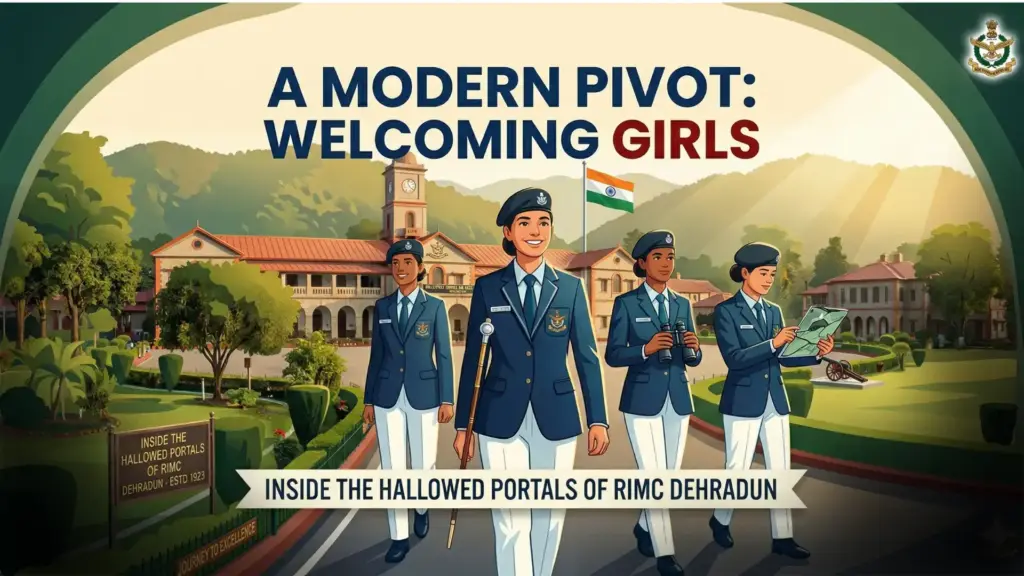
In 2022, RIMC broke a 100-year tradition by opening its doors to girl cadets. This wasn’t just a policy change; it was a historic evolution. Today, young girls are marching shoulder-to-shoulder with boys, scaling the same obstacles, and aiming for the same AIR (All India Ranks) in the NDA. The academy has adapted its infrastructure while keeping its standards of “grit and glory” exactly the same for everyone.
Conclusion: Is RIMC Right for You?
Admission to RIMC is a state-wise battle. Usually, only one seat is allotted per state, meaning your child must be the best in their entire state to get in. It is for the child who doesn’t just want to “study” but wants to “serve.”
The RIMC motto, “Bal Vivek” (Strength and Wisdom), perfectly encapsulates the journey. It’s a place that takes a 12-year-old child and, through a “trial by fire,” produces a leader ready to command men and women in the toughest terrains on Earth. If you seek a life of purpose, the journey starts at the gates of Garhi Cantt, Dehradun.
FAQ’s
1. Can my child join in Class 6 like Sainik School?
No. RIMC only takes admissions for Class 8. Your child should be studying in Class 7 when applying.
2. What is the exact age limit for the July 2026 term?
The candidate must be between 11½ and 13 years old. For the July 2026 intake, the birth date must fall between July 2, 2013, and January 1, 2015.
3. Is RIMC now open for girls?
Yes. RIMC is now fully co-educational. Girls follow the exact same entrance process and training standards as boys.
4. How many seats are actually available per state?
It is extremely tough. Usually, there is only one vacancy per state. Some larger states might occasionally have two, but it’s a “winner-takes-all” scenario.
5. Can I use a photocopied application form?
No. RIMC only accepts original forms with the official hologram. You must buy the prospectus directly from RIMC Dehradun via their website or a Demand Draft.
6. What are the “passing marks” for the written exam?
You must score at least 50% in every subject (English, Maths, and GK) individually. Failing even one subject disqualifies you from the interview.
7. Where do I submit the filled-out form?
Do not send it to Dehradun. The form must be submitted to your respective State Government (usually the Rajya Sainik Board or Education Department) of your domicile state.
8. My child wears glasses. Are they eligible?
Yes, within limits. Corrected vision is generally okay if it’s within -1.5D to +2.5D. However, color blindness or permanent eye defects are grounds for rejection.
9. Is there any negative marking in the exam?
No. There is no negative marking, but since the papers (especially Maths and English) are descriptive, the quality of writing and step-by-step solving matters more than just the final answer.
10. What is the annual fee and are there scholarships?
The annual fee is approximately ₹1.48 Lakhs (including a refundable security deposit). Most state governments provide merit-cum-means scholarships that can cover a significant portion of this.